



It’s the middle of the third quarter of a 20-point game. White hits a 3-pointer, and their point guard decides to guard blue’s point guard all the way up the floor. You are in lead transitioning to trail. You slipped up the court too quickly and are even with the ball when—BANG! White 15 jumps in front of blue 3, and there is a huge collision.
What’s your call, ref?
The instant you blow your whistle, you are on stage. Everyone saw the crash, and almost all of them expect an offensive foul. You don’t believe the defender obtained legal guarding position.
You have a block.
What happens next may shape the rest of your night—not necessarily because of the call itself, but because of what everyone believes about you after you make it. Do the players believe you saw the whole play? Does the coach believe you understand why you made the call? Do your partners believe you are certain? When the game gives you a difficult moment, does everyone feel as if the situation is under control?
That is court presence.
One definition of presence is “an invisible spirit that is felt nearby.” While you are not a ghost out there, everyone involved in the game—players, coaches, fans and your partners—can feel your presence. They can feel its absence, too.
After spending a career officiating at the highest levels of basketball, including the NBA Finals, I have come to believe that presence is not primarily about looking the part. It is about creating believability, anticipating what the game needs and providing leadership when certainty is difficult to find.

Presence Creates Believability
When officials talk about court presence, we often begin with posture, voice, signals, movement and appearance. Those things matter because of what they create.
They create believability.
The higher I advanced in my NBA career, the more I understood that getting a play right was only part of the job. The players were faster, the decisions happened more quickly and the pressure surrounding every call became greater. By the time you are officiating an NBA playoff or Finals game, no one needs a referee who simply knows the rules. They need someone whose judgment they can trust in a difficult environment.
That trust does not begin with one great call. It develops through dozens of small moments. How do you walk onto the floor? Do your movements have purpose? What happens to your body language when a coach challenges you? Do you look different after a difficult whistle than you do after an obvious one?
Players and coaches are constantly reading those signals, even if they cannot explain exactly what they are seeing.
During a RefMasters University session, Kane Fitzgerald and I studied a block-charge play. There were mechanical details we could debate, but the first thing that stood out was the calling official’s decisiveness.
You believed him.
A strong presentation cannot make a bad decision correct. Film will eventually expose the truth. But when you have made the right decision, your presence helps everyone else trust it.
Think again about our collision. If you step backward, drop your eyes and deliver the call as if you hope no one noticed, you communicate uncertainty before the coach says a word. If you step toward the moment and make it clear that you saw the defender arrive late, you give everyone a reason to believe you.
The coach may still disagree. That is basketball.
But disagreement and disbelief are not the same thing.
A coach can disagree with your judgment and still believe you understood the play. Once coaches and players stop believing you understand what is happening, the game becomes much more difficult to manage. Credibility is one of an official’s most valuable forms of currency, and court presence helps you earn it.
The Best Presence Is Proactive
We usually notice court presence after something happens. There is a whistle, a signal or a conversation with a coach. But the best officials show presence before the moment arrives.
They anticipate.
That may be the biggest difference I notice when I watch developing officials through RefMasters. Younger referees tend to react to the game. More experienced officials begin to recognize what the game will need next. They see a matchup becoming more physical before the contact escalates. They anticipate a coach’s question, recognize when a late-game situation may create confusion and know when a partner is likely to need information.
During one RefMasters University film session, we watched an out-of-bounds play in which the lead official needed help from the center. The center eventually provided the information, but his body language told the story. He was not ready. The lead had to find him, and only then did the center react. That slight hesitation changed how the entire sequence looked.
Kane brought up Scott Foster as an example of the opposite. When Scott has information that may help a partner, he will often take a few steps toward the play. He is not taking over the call and may not say anything. Those steps simply communicate: I’m here. I saw it. I have information if you need me.
That is court presence.
The difference between reacting and anticipating may be only two steps. But those two steps tell your partners—and everyone watching—that you are engaged.
I learned during my NBA career that much of game management is really problem recognition. What is about to happen? Where is the next point of tension? What information will my crew need? What can I address now so it does not become a larger problem later?
Consider a late-game free throw when everyone knows an intentional miss may be coming. Presence is not about making yourself the center of attention. It is recognizing the situation and making sure the players understand what is expected before the ball is released.
You are not reacting to confusion. You are preventing it.
That is when court presence becomes more than presentation. It becomes awareness. The official with great presence is not simply telling everyone what happened. That official is preparing everyone for what comes next.
Presence Is Knowing What to Do Next
Every referee experiences uncertainty. I experienced it during my NBA career. The game moves too quickly, and the plays are too difficult, for any official to feel completely certain in every moment.
Presence is not pretending otherwise.
Presence is knowing what to do next.
If you need information from a partner, get it. If the crew needs to come together, identify the question, share what everyone saw and make a decision. There is nothing weak about asking for help. What damages credibility is looking as though you do not have a plan.
Body language becomes especially important during those moments. If one official is staring at the floor, another has his hands on his hips and a third is shrugging, the crew has communicated uncertainty to the entire building. Eventually, it may not matter what the final decision is. No one will believe it.
Leadership does not require having every answer immediately. Sometimes leadership means calmly creating a process for finding the answer.
When a coach challenges you, presence is not automatically becoming louder or more forceful. It is listening, understanding the question and responding like someone comfortable with the decision.
And when you make a mistake, presence means admitting it.
Sometimes the most credible thing an official can say is, “Coach, I missed it.”
Court presence cannot compensate for poor decision-making. A booming voice and perfect signals will not make an incorrect ruling correct. Real confidence does not require defending the indefensible. It allows you to acknowledge a mistake without letting that mistake define the next play.
That is something the NBA taught me. Even the most accomplished officials miss plays. The standard is not perfection. The standard is preparation, accountability and the ability to remain ready for whatever the game asks of you next.

The Little Things Tell a Story
One of the things I enjoy most about working with developing referees through RefMasters is watching them begin to see the game differently.
At first, they watch the call. Was it a block or a charge? Was the player in the act of shooting? Who caused the ball to go out of bounds?
Then we watch the film again.
Now we notice where the official’s eyes were before the play. We notice how the official moved after the whistle. We see whether their shoulders dropped when the coach reacted and whether they were ready when a partner needed help. We notice the half-second of hesitation that changed how everyone perceived the decision.
Those details may seem small.
They are not.
Together, they tell a story: I belong here. I understand what is happening. I am engaged with my crew. I am ready for the next moment.
Or they tell the opposite story.
That is why film is such an important development tool. But you cannot only watch your calls. You have to watch yourself. Watch how you enter the floor, your body language after a difficult whistle, what happens when a coach challenges you and how you respond when a partner needs information. Compare the moments when you are certain with those when you are not. You will see the difference.
You also should not always watch yourself by yourself.
It is difficult to evaluate your own presence because you already know what you were thinking. You may not notice how your posture changed or how a moment of hesitation affected an otherwise correct decision. Another official may see it immediately.
That is why studying film with other referees is so valuable. You need experienced people who will challenge your perspective, point out what you missed and help you understand not only what they see, but how they see the game.
That is what we do inside RefMasters University. We may begin with a play, but the conversation often becomes much bigger than the ruling. We talk about credibility, anticipation, communication, leadership and the small details that determine whether an official looks ready for the next level.
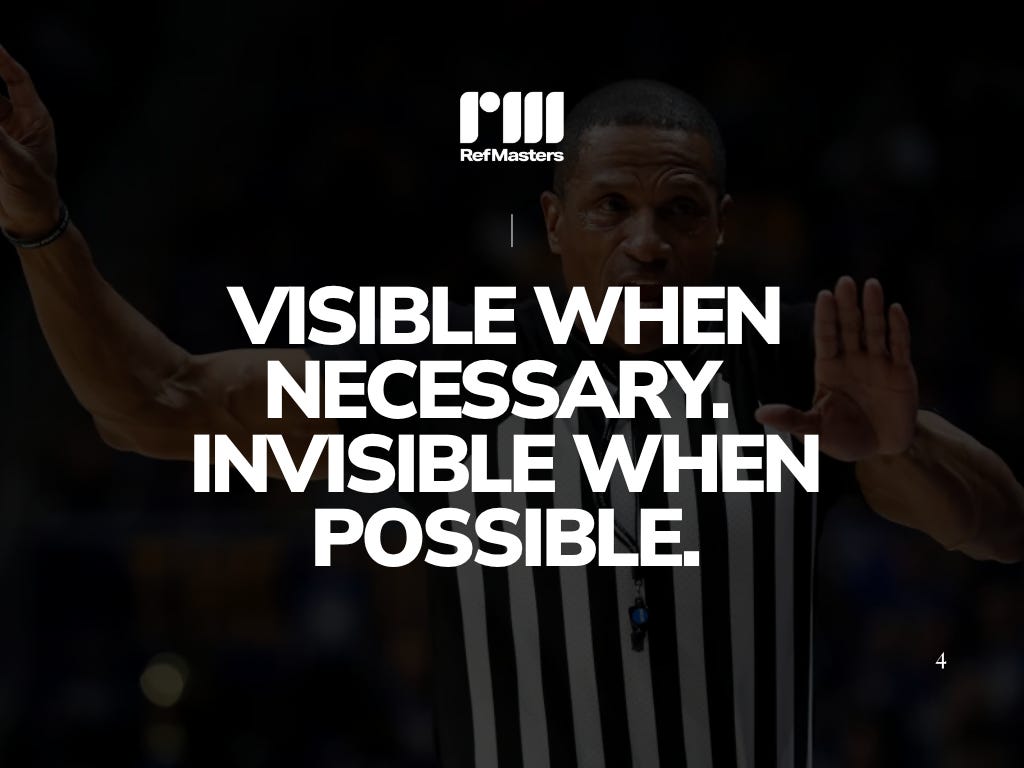
The goal of court presence is not to become the star of the show. The best presence often does not demand attention at all. It simply gives the game what it needs: visible when necessary, invisible when possible, available when needed, assertive when required and calm at all times.
That balance allows you to run the game without becoming the game.
Court presence is not one big thing. It is how you enter the floor, respond to pressure, anticipate problems, help your partners and recover when you are wrong. It is the invisible spirit everyone around you can feel.
Work on that spirit. Study it on film. Most importantly, study it alongside officials who will challenge what you see and help you recognize what you cannot recognize alone.
That is why I tell officials they need to be part of RefMasters University. It gives us a place to study the game together, learn from people who have worked at its highest levels and have the conversations that make all of us better.
Because the little things tell everyone whether you are ready to run the game.


So many things to relate to! Fantastic piece of work